

Global Sports Betting Legalization Status and Case Studies by Country

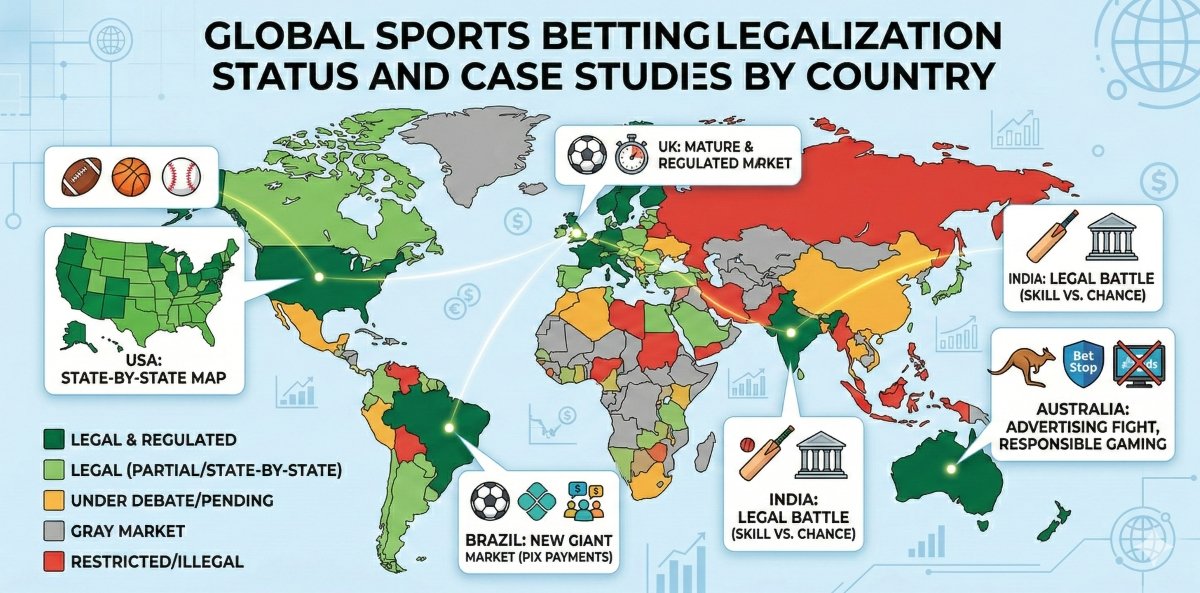
By 2026, the global landscape of sports betting looks very different than it did just a few years ago. Governments worldwide have recognized that people will bet on sports regardless of legality. Instead of fighting it, many countries now regulate betting to protect players, reduce illegal activity, and generate billions in tax revenue. Each nation, however, has taken its own approach.
The United States: A Patchwork of Rules
The U.S. is one of the most notable examples of rapid change. Since the federal ban was lifted, states have rushed to establish their own regulations. By early 2026, more than 30 states had fully launched mobile betting apps.
Missouri is a recent success story. After voters approved legalization in late 2024, online betting went live in December 2025. Fans in St. Louis can now place regulated bets directly from their phones at stadiums. Yet, major states like California and Texas remain without legal markets due to ongoing political debates, creating a patchwork system where betting is legal in one state but prohibited across the border.
The United Kingdom: A Mature Market Focused on Safety
The UK represents a mature market where betting has been legal for decades. With growth already established, the government now emphasizes safety and oversight.
In April 2026, the UK raised the tax on online gaming to 40 percent, aiming to discourage companies from pushing high-risk games such as digital slots. New affordability checks also require operators to verify whether players can realistically afford their wagers. For example, if a young fan deposits an unusually large sum, the system may pause their account. In the UK, “legal” now also means “supervised.”
Brazil: South America’s New Giant
Brazil has become one of the most dynamic stories in global betting. For years, millions of Brazilians relied on offshore “grey market” sites. In January 2025, the government launched a fully regulated system.
By 2026, Brazil had licensed more than 75 operators under strict rules. Credit cards are banned, with payments limited to debit cards or the local instant system Pix, preventing overspending. The government collects 12 percent of operator revenue, which is reinvested into schools, police, and sports programs—making legalization a tool for social improvement as well as entertainment.
India: At a Legal Crossroads
India’s situation is more complex. With millions of cricket fans, demand is enormous, but laws remain tangled. In 2025, a new online gaming law was passed but quickly challenged in court.
By early 2026, the Supreme Court was debating whether fantasy sports and similar games are based on “skill” or “chance.” Skill-based games are often legal, while chance-based games are treated as gambling and may be banned. Meanwhile, a 28 percent tax on deposits has strained smaller companies, highlighting India’s struggle to balance regulation with accessibility.
Australia: Tackling Advertising Fatigue
Australia has one of the highest betting participation rates globally. With such widespread activity, fans complained of “ad fatigue,” saying broadcasts were saturated with betting promotions.
In 2026, Australia introduced strict advertising rules, banning betting ads during times when children are likely to watch. Credit card betting was also prohibited nationwide. The country now operates “BetStop,” a national registry allowing individuals to self-exclude from all betting apps with a single action.
Summary of Global Status
| Country | Status in 2026 | Primary Focus |
| USA | State-by-state legalization | Rapid expansion and tax revenue |
| UK | Fully regulated | High taxes and affordability checks |
| Brazil | Newly regulated | Pix payments and social reinvestment |
| India | Ongoing legal battle | Skill vs. chance debate |
| Australia | Highly regulated | Ad restrictions and credit card bans |
The global trend is clear: sports betting is moving into the open. By establishing clear rules, countries are transforming a once-controversial activity into a regulated industry that supports safety, generates revenue, and even funds social programs.