

Introduction
Efficiency is often the hidden currency of football. While possession statistics and shot counts dominate headlines, the true measure of attacking success lies in the quality of chances created and converted. Suwon FC’s recent 3–1 victory over Yongin City in the K League 2 offered a textbook case study in this principle. Scoring three goals from just 12 total shots, Suwon demonstrated how transition play and shot quality can outweigh sheer volume. Their performance provides both analysts and fans in Gyeonggi-do with a lens to understand how efficiency metrics are reshaping modern football.
The Match: Suwon’s Clinical Edge
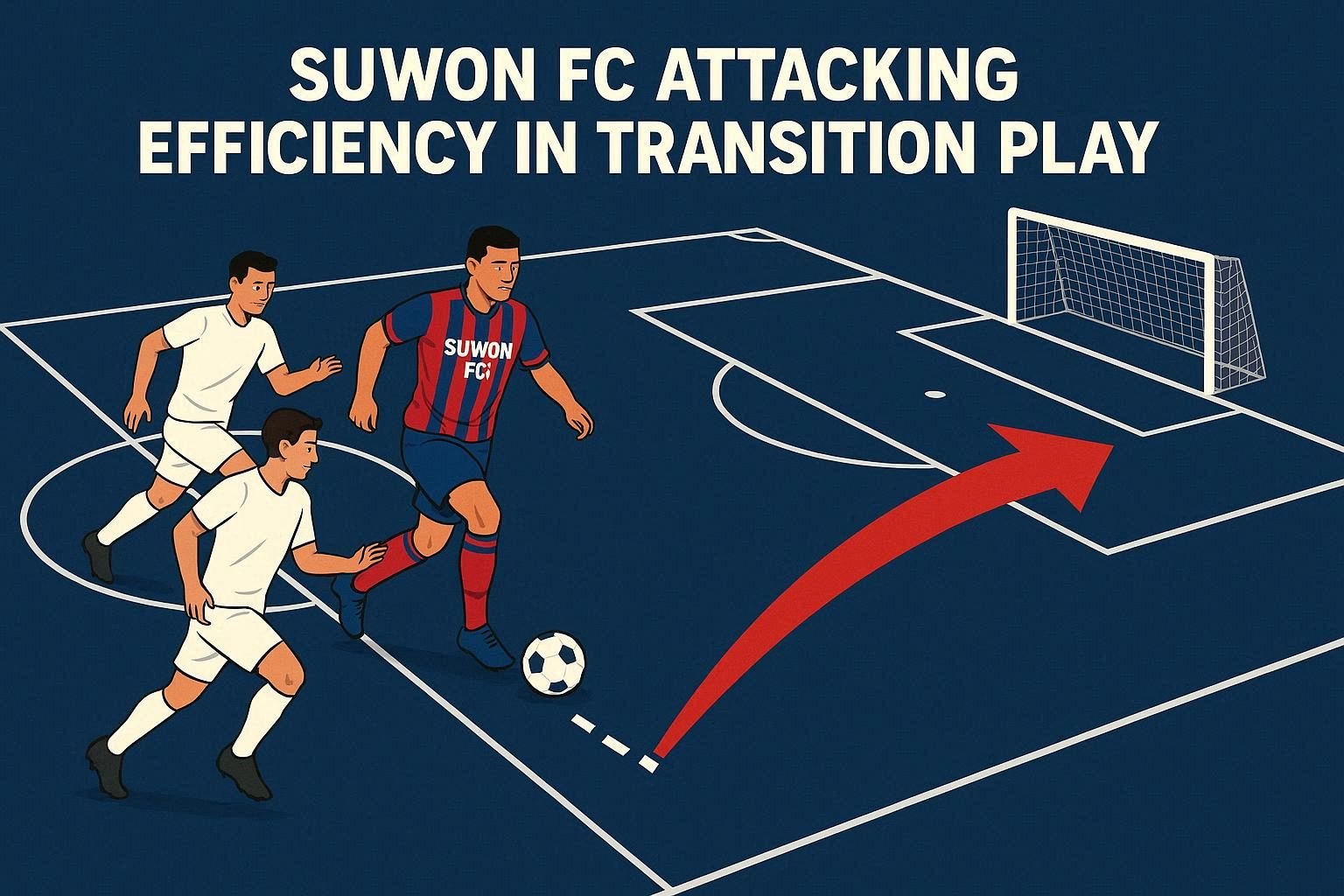
Against Yongin City, Suwon FC did not overwhelm with possession or relentless shooting. Instead, they capitalized on turnovers and transitional moments. Each of their three goals came from sequences where Yongin lost the ball in midfield or advanced areas, and Suwon quickly transitioned into attack.
- Shot Count: 12 total shots.
- Goals Scored: 3.
- Goals-per-Shot Ratio: 0.25, significantly above the league average of approximately 0.10–0.12 (StatsBomb).
This efficiency underscores Suwon’s tactical identity: they prioritize high-value opportunities over speculative attempts. Rather than peppering the goal with low-probability shots, they wait for moments when the defense is disorganized, striking with precision.
Transition Play as Tactical Identity
Transition play refers to the rapid shift from defense to attack, often triggered by turnovers. Suwon FC’s offensive profile emphasizes this approach:
- Directness: Minimal passes between winning the ball and shooting.
- Verticality: Quick progression upfield, exploiting space behind the opposition’s defensive line.
- Exploiting Chaos: Targeting moments when opponents are least organized, maximizing chance quality.
This style contrasts with sustained buildup, where teams patiently circulate possession to create openings. Suwon’s philosophy is clear: efficiency thrives in chaos (The Analyst).
Shot Quality vs. Shot Quantity
The educational takeaway from Suwon’s performance lies in the analytics concept of shot quality versus shot quantity.
- Shot Quantity: Teams like Manchester City often dominate possession and generate 20+ shots per game (Opta Analyst).
- Shot Quality: Suwon’s 12 shots produced three goals because they were taken in high-value situations—close to goal, with defensive imbalance, or after turnovers.
Modern analytics emphasize expected goals (xG), a metric that assigns value to each shot based on location, angle, and defensive pressure. Suwon’s xG per shot was likely well above average, reflecting their focus on creating chances with higher conversion probabilities.
Case Study: The Three Goals
Breaking down Suwon’s goals against Yongin reveals the anatomy of transition efficiency.
- First Goal: A midfield turnover led to a three-pass sequence, ending with a striker through on goal. The shot was taken inside the box with minimal defensive pressure.
- Second Goal: Yongin lost possession near Suwon’s defensive third. A long ball exploited space behind the defense, and the winger finished clinically.
- Third Goal: A counterattack following a failed Yongin corner. Suwon transitioned from defense to goal in under 10 seconds, highlighting the speed and directness of their approach.
Each goal exemplified the principle: fewer touches, faster progression, higher shot value.
Comparative Analysis: League Trends
Suwon’s efficiency stands out in the K League 2 context. Many teams rely on volume shooting, believing that more attempts increase the likelihood of scoring. However:
- League Average Goals-per-Shot: ~0.10–0.12 (FBref).
- Suwon’s Match Ratio: 0.25.
This disparity illustrates how tactical identity can redefine success. Suwon’s approach may not produce the highest shot totals, but it maximizes conversion rates.
Educational Takeaway: Analytics in Action
For fans and students of football analytics, Suwon’s match offers a practical lesson:
- Efficiency Metrics Matter: Goals-per-shot and xG per shot provide deeper insights than raw shot counts.
- Transition Play Enhances Shot Quality: By attacking in moments of defensive disorganization, teams increase the likelihood of scoring.
- Local Relevance: Suwon’s tactical identity gives Gyeonggi-do fans a framework to understand how analytics concepts apply directly to their club.
This case study reinforces the broader shift in football analysis: success is increasingly measured by efficiency, not volume.
Fan Perspective: Gyeonggi-do Identity
For Suwon FC supporters, the team’s attacking efficiency resonates with local pride. Suwon, a city known for its balance of tradition and modernity, finds in its football club a reflection of calculated precision.
- Community Connection: Fans see their team as disciplined yet opportunistic, embodying resilience and pragmatism.
- Educational Lens: Local supporters gain exposure to advanced analytics concepts, enriching their understanding of the game.
- Cultural Symbolism: Suwon’s efficiency mirrors the city’s reputation for innovation and adaptability.
This tactical identity strengthens the bond between club and community, offering fans more than just entertainment—it provides intellectual engagement.
Tactical Risks and Rewards
Transition play carries inherent risks:
- Rewards: High-value chances, efficient scoring, and psychological pressure on opponents.
- Risks: Reliance on turnovers means fewer chances if opponents maintain possession discipline.
Suwon’s success depends on balancing these dynamics. Against teams with strong ball retention, they may struggle to generate opportunities. However, their efficiency ensures that when chances arise, they are maximized.
Broader Implications for the K League 2
Suwon’s performance has implications beyond a single match:
- Tactical Diversity: Their style adds variety to the league, contrasting with possession-heavy teams.
- Analytical Awareness: Matches like this encourage broader adoption of efficiency metrics among analysts and fans.
- Competitive Balance: By maximizing shot quality, Suwon can challenge more resource-rich clubs, leveling the playing field.
This evolution reflects the global trend: analytics-driven efficiency is redefining football success (Stats Perform).
Historical Context: Suwon’s Tactical Evolution
Suwon FC’s identity has evolved over time. Historically, they were seen as a mid-table club, often overshadowed by Suwon Samsung Bluewings. However:
- Recent Seasons: Emphasis on transition play has sharpened their competitive edge.
- Analytical Adoption: Coaches increasingly integrate data into tactical planning.
- Local Rivalries: Efficiency in attack distinguishes Suwon FC from their neighbors, carving out a unique identity.
For comparison, Suwon Samsung Bluewings have recently been praised for their defensive cohesion, a contrasting tactical identity that highlights the diversity of approaches within Suwon football culture (Suwon Insider).
Educational Framework for Fans
For fans in Suwon and Gyeonggi-do, the match against Yongin offers a framework to understand football analytics:
- Identify Shot Quality: Look beyond shot counts to assess chance value.
- Recognize Transition Moments: Observe how turnovers create high-value opportunities.
- Apply Efficiency Metrics: Use goals-per-shot and xG per shot to evaluate performance.
This framework empowers fans to engage with the game analytically, deepening their appreciation.
Future Outlook
Suwon FC’s attacking efficiency raises questions about sustainability:
- Can They Maintain Efficiency? High conversion rates often regress to the mean.
- Will Opponents Adapt? Teams may adjust by minimizing turnovers and tightening defensive transitions.
- Can Suwon Diversify? Adding buildup play options could balance their reliance on transitions.
The future will test whether Suwon’s efficiency is a sustainable identity or a temporary advantage.
Conclusion
Suwon FC’s 3–1 victory over Yongin City was more than a win—it was a case study in attacking efficiency. Scoring three goals from 12 shots, they demonstrated how transition play and shot quality can redefine success. Their goals-per-shot ratio of 0.25, well above league average, highlights the value of efficiency metrics in modern football.
For fans in Suwon and Gyeonggi-do, this tactical identity offers both pride and education. It provides a lens to understand how analytics concepts like shot quality versus shot quantity shape outcomes. As the K League 2 evolves, Suwon FC’s efficiency-driven approach may inspire broader tactical and analytical shifts, ensuring that football in Korea continues to blend tradition with innovation.